Physical Address
304 North Cardinal St.
Dorchester Center, MA 02124
Physical Address
304 North Cardinal St.
Dorchester Center, MA 02124

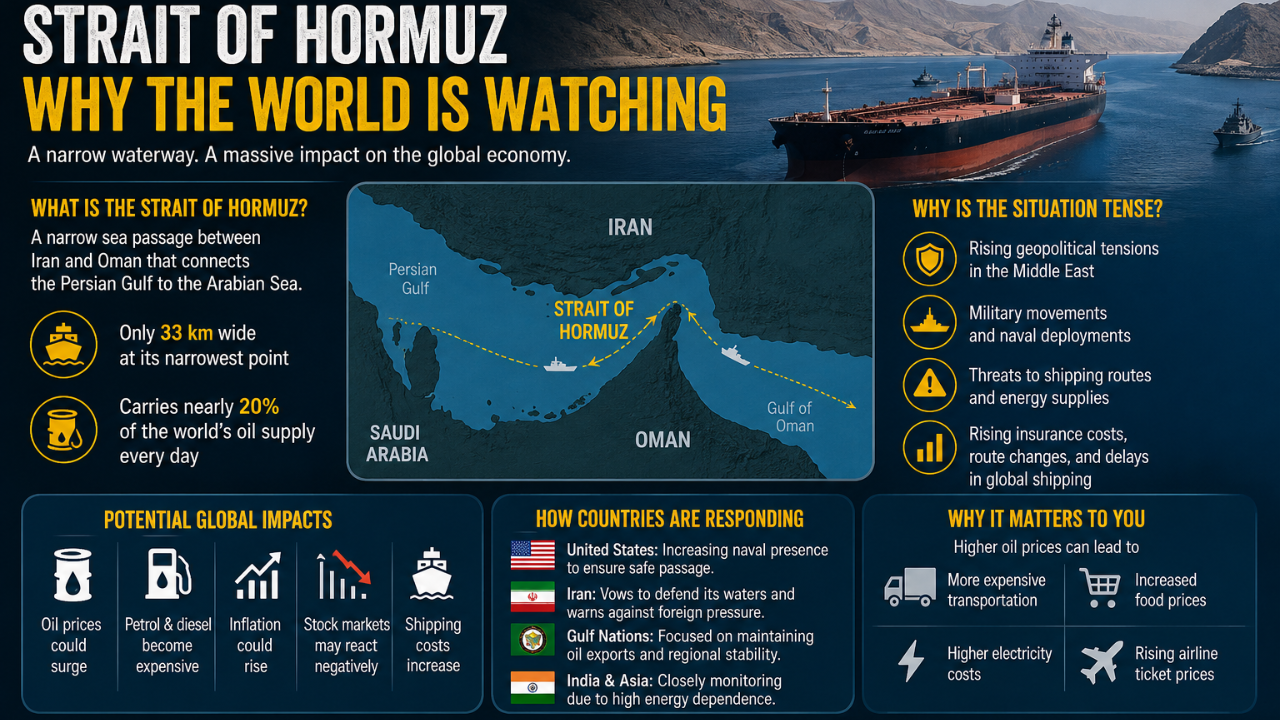
In recent weeks, the Strait of Hormuz has once again become the center of global attention. Rising tensions in the Middle East, military movements, and threats to shipping routes have created fears of another global energy crisis.
But why is this narrow stretch of water so important?
The answer is simple: the world’s economy depends on it.
The Strait of Hormuz is a narrow sea passage located between Iran and Oman. It connects the Persian Gulf to the Arabian Sea and the wider Indian Ocean.
Even though it is only around 33 kilometers wide at its narrowest point, it carries nearly 20% of the world’s oil supply every single day.
Countries like:
all depend heavily on this route to export oil and natural gas.
Without the Strait of Hormuz functioning smoothly, global energy markets can become unstable within hours.
The current tension is linked to growing geopolitical conflicts in the Middle East. Recent military activities, naval deployments, and political threats have increased fears that shipping traffic could be disrupted.
Several international shipping companies have already started:
This has created nervousness in global markets.
If the Strait of Hormuz gets blocked or attacked, the effects would not stay limited to the Middle East.
A disruption in oil supply can instantly push crude oil prices much higher.
Countries like India, which import large amounts of oil, may face fuel price increases.
Transportation and manufacturing costs would increase globally.
Investors often panic during geopolitical crises.
Global trade routes become more expensive and risky.
The US Navy has increased monitoring in the region to ensure safe passage for commercial ships.
Iran has warned against foreign military pressure and has repeatedly stated that it will defend its territorial waters.
Countries in the Gulf are trying to maintain oil exports while avoiding a larger conflict.
Asian countries are watching the situation closely because they rely heavily on Gulf energy supplies.
Yes — even people far away from the Middle East can feel the impact.
Higher oil prices can lead to:
That is why governments and financial markets closely monitor every development in the Strait of Hormuz.
Experts believe that while tensions are serious, most countries want to avoid a full-scale conflict because the economic consequences would be massive.
However, even small incidents in the region can create global panic because of the Strait’s strategic importance.
The situation remains highly sensitive and can change rapidly.
The Strait of Hormuz may look like a tiny waterway on the map, but it plays a massive role in the global economy.
Every tanker passing through it carries not just oil — but economic stability for millions of people worldwide.
As tensions continue, governments, businesses, and ordinary citizens alike are keeping a close eye on developments in this critical region.
Because it carries around 20% of the world’s oil supply.
Iran and Oman border the strait.
Technically yes, but it would have major global economic consequences.
India could face higher fuel prices and inflation due to increased oil costs.





Hello nice post
[…] Strait of Hormuz Crisis 2026: Why the World is Watching This Tiny Waterway ← Previous Post […]